



Why Does SEO for Personal Injury Lawyers Matter?
Uncategorized Why Does SEO for Personal Injury Lawyers Matter? Written by drennamdi@gmail.com Published on September 6, 2025 Share This Why Does SEO for Personal Injury Lawyers Matter? The world of personal injury law is fiercely competitive. Clients searching for representation rarely scroll past the first page of Google. If your firm isn’t showing up where your potential clients are searching, you’re losing cases before they even begin. This is where local SEO for law firms comes in. Let’s take it one step at a time and understand much thoroughly, shall we What is SEO for Personal Injury Lawyers? Search Engine Optimization (SEO) is making a website so it is further up in search engines like Google. For personal injury lawyers, SEO is not ego traffic; it’s about showing up when someone types “car accident attorney near me” or “personal injury lawyer free consultation.” Alt text: A stylized illustration of a laptop displaying a Google search page with a prominent red upward arrow and graph lines indicating growth. The screen features SEO-related icons, including a magnifying glass, a gear, and a document. Surrounding the laptop are additional symbols of success and analysis, such as a star, bar charts, and a line graph, all set against a light background with cloud-like shapes. Easy aspects of SEO for legal practices are: Attorney Keyword Research – Uncovering keywords that customers are actually searching for (i.e., “slip and fall lawyer Dublin” rather than simply “lawyer”). On-Page SEO – Getting service pages, blog articles, and FAQs keyword-directed, schema-markup-supported, and accessible. Local SEO – Getting your law firm listed on Google Maps, local search, and the “near me” searches, which dominate personal injury law. Content Strategy – Writing FAQs, blog posts, and guidelines regarding popular legal topics and the exercise of authority. Link Building – Acquiring links from quality, relevant websites to establish credibility. Technical SEO – Having your site load fast, function on mobile, and adhere to Google’s guidelines. So you see… SEO is a highly effective law firm content marketing technique. The technique you’d implement toward improved organic visibility and accelerated client procurement. Without it, you are missing out on being found in an area where the first found is halfway to victory. Why Niche SEO Matters More Than Ever Niche SEO matters more now than ever before because it’s aimed at certain groups of people with specially designed content, making agencies get ranked in search engines, become visible, and convert visitors with ease. You see… Not all SEO is created equal. What might be acceptable for e-commerce or restaurant websites, legal SEO, and more so for personal injury lawyers, requires precise finesse. Here’s why, in greater detail for you— 1. The legal market is too saturated The personal injury lawyer is one of the most competitive verticals online. National directories, aggregators, and other participants are all after the same high-value terms. Smaller practices become buried under larger ones without a niche SEO strategy. 2. High value requires high trust Compared to shopping for shoes online, choosing a personal injury lawyer is a major life choice. Clients must enjoy their lawyer. It’s a high Google search ranking, i.e., credibility and ability, usually prior to even making the first call by the potential client. “One study even found that organic searches generate approximately 66% of call conversion for PI law firms.” 3. Local intent influence searches Most clients prefer lawyers in their locality or city. Keywords like “personal injury lawyer near me” or “best car accident lawyer in Dublin” are signals of local search intent. Local SEO will get your firm listed in Google’s Map Pack (the first 3 listings below the map), where most of the clicks are received. 4. SEO wins out in the long run over ads Google pay-per-click (PPC) advertisements for personal injury firms can range from hundreds to thousands of euros per click. SEO, if you invest, brings long-term organic traffic that will not disappear overnight the day you cease paying. In the long term, SEO is the cheapest channel for consistent case leads. “Organic click-through rates range from 2.5% to 40%. Standard pay-per-click advertising, on the other hand, maxes out at meager 5%.” 5. Clients are doing more research than ever Most clients spend hours reviewing law firms online before contacting them. They look at reviews, read attorney bios, and review case results. SEO makes your firm’s content and reputation appear where it counts, ahead of competitors, and gives you the opportunity. “Research shows that users browsing a page have a strong preference for organic results compared to paid ads, with 82% of them viewing the organic results first.” Primary Benefits of SEO for PI Lawyers Better Quality Leads: SEO brings users actively looking for personal injury legal services, which is likely to improve the chances of converting the visitors to clients. Increased Brand Awareness: Consistent display in search results builds familiarity and credibility with prospects over a long time. The more your law firm is exposed online, the more they will remember and recommend you. Better ROI Than Ads: As opposed to paid advertising, which stops once a budget is spent, SEO offers compounding returns in the form of continued traffic and visibility. Better Reputation: Being at the top of search results conveys professionalism and authority, which increases client trust. Long-Term Competitive Edge: By investing in SEO from the very beginning, law firms are able to outcompete their competitors and take over search rankings for local searches. Especially because local searches are responsible for almost 23% of website traffic. How Hazlflow Helps Legal Firms Dominate Local Search Local search is the bread and butter of personal injury law firms. And this is how we, Hazlflow, help law firms like personal injury law firms dominate local search with our niche-specific SEO approach: 1. Google Business Profiles (GBP) optimisation Your Google Business Profile is likely to be your potential clients’ first impression of you. With proper optimisation, you will be featured in the Google Map
What Does It Mean Scaffolding In Web Design?
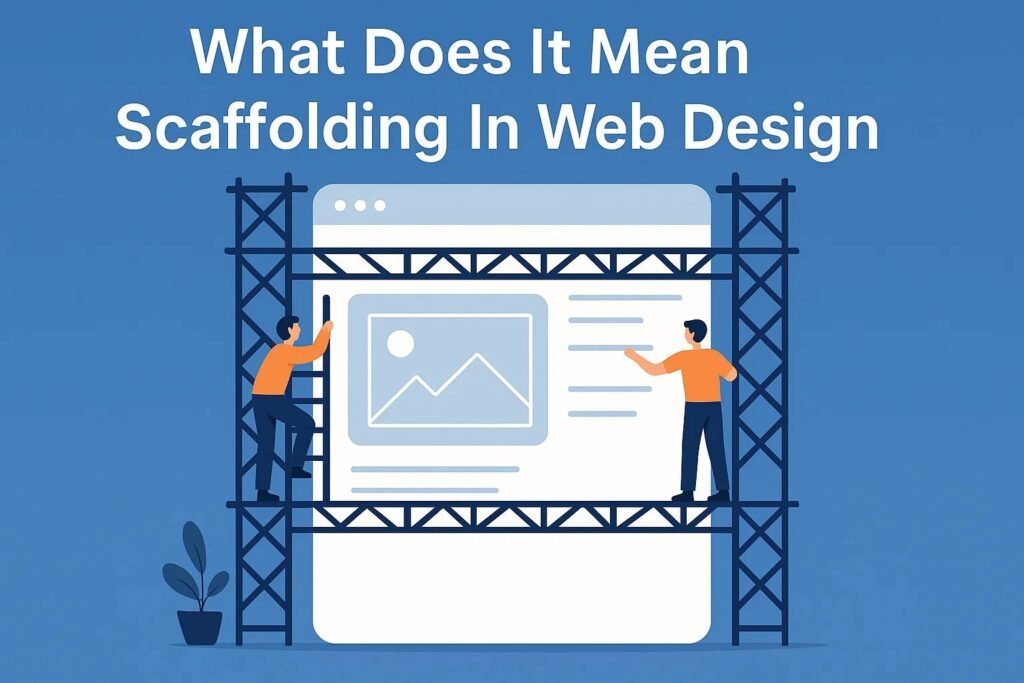
Uncategorized What Does It Mean Scaffolding In Web Design? Written by Anik Published on August 20, 2025 Share This Strategic Budgeting: A Key to Business Sustainability Scaffolding in web design is the first step to take before diving into the intricate details of designing, developing, and structuring the website. Think of it like this: when drawing something, you’d start by sketching the outline, right? If you draw one object and wait until you’re done coloring and designing, it’ll take way too long to complete. You might also find the final design hard to follow, since the overall focus becomes fragmented. But sketching first helps to hold the focus while also making faster progress. Okay, let me write some more about what does it mean scaffolding in web design. It’s the same with scaffolding. Making it easy to guide users’ focus smoothly through your site… presenting the right information at the right time in the right place. Since navigation and content hierarchy are predefined with scaffolding, developer teams find it much easier to work with, and users find it much easier to browse through. So… no more irritated potential clients, only more and more engagement! What Does It Mean Scaffolding In Web Design? Scaffolding in web design is the blueprint of your site. Something your developer can rely upon to rapidly create the basic infrastructure to achieve the desired output. Results? A website that doesn’t lose focus of the main intent and customers find it fun and easy to browse through. It’s a temporary structure that highly affects your website’s simplicity, consistency, prototyping speed, and reusability. And, because of its diverse usefulness, it becomes much easier for you to maintain an organized pattern. So, even if there’s anything wrong, you can take action and resolve it in no time. Key elements of scaffolding in web design: Clear hierarchy of content (what’s most important, what’s secondary) Consistent navigation so users never feel lost Consistent layouts so similar pages “feel” the same Guided pathways to the next logical step. Why Scaffolding Matters in Modern UI/UX Scaffolding matters in modern UI/UX the most. Why? Imagine landing on a webpage that feels like a cluttered desk. What you need is really there, but finding it is such a mess. That’s what happens when scaffolding is not at work. But when scaffolding is at work, many aspects of the overall UI/UX start to improve rapidly. For example, you’ll achieve- Clear Navigation: Users can easily locate what they’re looking for without hesitation or backtracking. Logical Content Flow: Content is presented in a genuine, easily consumable flow — from curiosity to conversion. Focused User Attention: Intentional design engages users with relevant pieces and discourages distractions and bounce rates. Faster Development Cycles: With a pre-defined layout, design, and dev teams can collaborate more efficiently and avoid costly rework. Responsive Consistency: Scaffolding is applied to maintain visual and functional consistency across devices and screen sizes. Better Accessibility: An ordered structure makes it easier to adopt accessibility guidelines, allowing for greater usability across all. How Hazlflow Uses Scaffolding in Real Client Projects To Hazlflow, Scaffolding at Hazlflow isn’t just a technical operation. We take significant consideration since it’s the key to all our successful online ventures and client satisfaction. Whether we’re working on a profit-building e-commerce site or a non-profit research website, scaffolding allows us to define the structure, streamline workflows, and ensure that every aspect has a well-defined reason. We’ve faced multiple challenges along the road, and this is how we use scaffolding to provide you with smarter solutions: Easy Site Structure: We start by outlining the overall organization of your site, pieces, and user flows so nothing gets left behind. This improved the client sites’ usability and SEO by having clean, crawlable hierarchies. Speedy Prototyping: Scaffolding allowed us to produce wireframes and mockups with much faster speed, so clients can see the end product early on. It also sped up our development by removing guesswork throughout the team. Consistent Code & Design: With a solid scaffold in place, our developers and designers are always speaking the same language. This translates into fewer redesigns, smoother collaboration, and a cleaner end product. SEO-Friendly Layouts: We use scaffolding to create keyword-rich content placement, internal linking practices, and mobile-friendly layouts. Ultimately, making sure that our client’s site ranks high in search engines. So you see… by including scaffolding in every stage of our development cycle, Hazlflow makes sure that every project is not only beautifully developed but also architecturally built with performance, scalability, and findability in mind. Ready to transform your digital experience? Contact Hazlflow today. Real-World Results from Client Transformations We’ve seen our clients cut bounce rates simply by reorganising their scaffolding. In fact, one client’s e-commerce didn’t have a proper UI/UX strategy, causing poor conversions. But with our scaffolding, we saw their comments going from “Where do I find that?” to “I just bought three things I didn’t even plan to.” We also helped with a full website redesign for a healthcare website. Since their previous website was outdated, it had quite a few security issues. Nevertheless, Hazlflow took care of all efficiently. Wanna learn more about our projects and achievements? Make sure to take a look at Hazlflow’s web design case studies. Final Thoughts Scaffolding in web design isn’t about fancy animations or eye-catching graphics—it’s about making sure the bones of the site are strong enough to support a smooth, intuitive experience. Without it, even the prettiest design can leave users confused. Thanks for reading the full article, hopefully you have learned and understand what does it mean scaffolding in web design. 1. Nam libero tempore, cum soluta nobis est eligendi optio cumque nihil. 2. emporibus autem quibusdam et aut officiis debitis aut rerum. 3. Itaque earum rerum hic tenetur a sapiente delectus utaut reiciendis elitasiroa. 4. Duis aute irure dolor in reprehenderit in voluptate velit esse cillum. 5. Ixcepteur sint occaecat cupidatat non proident, sunt in culpa qui officia. “Financial consulting is not